Concrete Driveway Cost in Durham: What $8 to $18 per Square Foot Buys
Most homeowners searching for concrete driveway cost in Durham find a number somewhere between $8 and $18 per square foot and immediately hit the same wall: that is more than a two-to-one spread. On a 600 square foot driveway it is the difference between roughly $4,800 and $10,800. Nobody can budget around a range that wide without knowing what moves a project from one end to the other.
So here is the part most cost guides skip. That $8 to $18 spread is not the difference between a plain driveway and a fancy one. It is the range for a standard broom finish, the most basic option we pour. Decorative work sits on top of it. What moves a broom finish driveway from $8 to $18 is almost entirely site conditions: how the truck gets in, what is already there, what the ground underneath is doing, and how thick the slab needs to be for what you park on it.
This guide breaks down where every dollar goes, what pushes a Durham quote up or down, and how to run the math yourself before anyone shows up with a clipboard.
What a Concrete Driveway Costs in Durham by Size
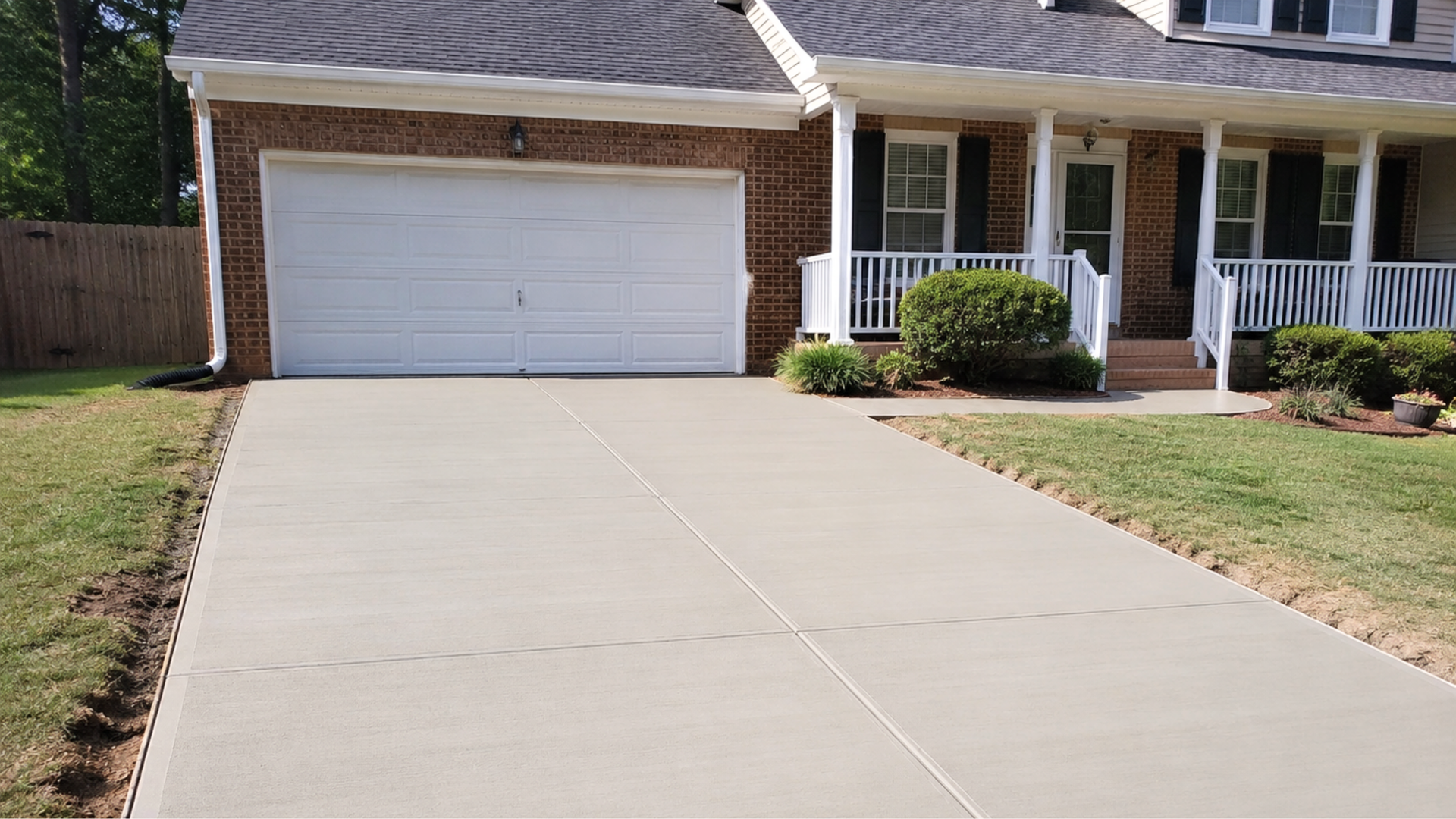
Here is what the $8 to $18 range works out to for common Durham driveway sizes, assuming a standard broom finish. These are planning numbers, not quotes.
| Driveway | Approx SF | Low End ($8/sq ft) | High End ($18/sq ft) |
|---|---|---|---|
| Single car, 12 x 24 | 288 | $2,300 | $5,200 |
| Single car long, 12 x 40 | 480 | $3,800 | $8,600 |
| Two car, 20 x 24 | 480 | $3,800 | $8,600 |
| Two car standard, 20 x 30 | 600 | $4,800 | $10,800 |
| Two car with turnaround | 800 | $6,400 | $14,400 |
| Large or circular | 1000 | $8,000 | $18,000 |
| Extended or multi-vehicle | 1200 | $9,600 | $21,600 |
Most Durham homeowners replacing a standard two-car driveway land somewhere in the middle of that band. A straightforward replacement on a flat lot with good truck access sits near the low end. Add demolition, a slope, a drainage problem, and a thicker slab and you are at the top.
Why the Range Is So Wide
What You Get Near $8 per Square Foot
The low end is not a cheaper product. It is an easier job.
- New construction or a pour over ground that is already prepped, so there is nothing to tear out
- Flat or gently sloped lot with no regrading required
- Open access, meaning the truck can back close to the pour without pumping or wheelbarrowing
- Standard 4 inch slab, which is the minimum we use for residential driveways
- Wire mesh reinforcement rather than rebar
- Simple rectangle with straight forms and no curves or borders
- No drainage work and no apron replacement
What Pushes a Quote Toward $18
Every item below adds real labor, material, or equipment. None of them are upsells.
- Demolition and haul-off of an existing slab
- Tight access, meaning concrete has to be pumped, buggied, or wheelbarrowed in
- Significant grading or a steep approach
- Drainage correction, which can mean regrading, a channel drain, or reworking where water exits
- A 5 or 6 inch slab, which we recommend when RVs, trailers, or work trucks will use it
- Rebar instead of mesh
- Curves, flares, borders, or a circular layout
- A new apron or curb cut, which brings city permitting into the picture
- Poor subgrade that needs to be dug out and replaced with compacted stone
Cost Breakdown by Finish Type
Finish is priced on top of the base. A broom finish is included in the ranges above. Everything else is a premium per square foot, layered on whatever your site conditions already dictate.
| Finish | Typical Premium | What You Are Paying For |
|---|---|---|
| Broom finish | Included in base | Traction texture, lowest upkeep |
| Smooth trowel | Small premium | Extra troweling passes |
| Integral color | Low premium | Pigment batched into the mix |
| Exposed aggregate | Moderate premium | Richer mix, wash and timing |
| Acid stain or topical | Moderate premium | Surface prep, stain, sealer |
| Stamped, single color | Higher premium | Hardener, mats, detail, sealer |
| Stamped, multi-color | Highest premium | Layered color and hand detail |
A few notes worth having before you pick.
Broom finish is the default for a reason. It grips when wet, it hides minor staining, and it is the cheapest surface to maintain over 25 years. Most of the driveways we pour across Durham are broom finish, and most homeowners are happy with that choice. You can see both broom and decorative work side by side in our project gallery.
Stamped is where the money goes. The premium is not markup. Stamped work needs color hardener, release agent, stamp mats, hand detailing on every edge and seam, and a sealer coat that has to be reapplied every few years. It also has to be finished inside a narrow window while the slab is at exactly the right firmness, which is why we schedule decorative pours carefully. Our stamped concrete page covers the patterns and colors we work with.
Integral color outlasts topical color. Pigment mixed at the plant goes all the way through the slab, so a chip does not expose gray underneath. Topical stains look great on day one and fade faster outdoors.
Smooth trowel finishes get slick. They look sharp, but on a sloped Durham driveway in a rainstorm they are a genuine safety issue. We will pour one if you want it, but we will tell you that first.
What Actually Drives the Price
Site Access
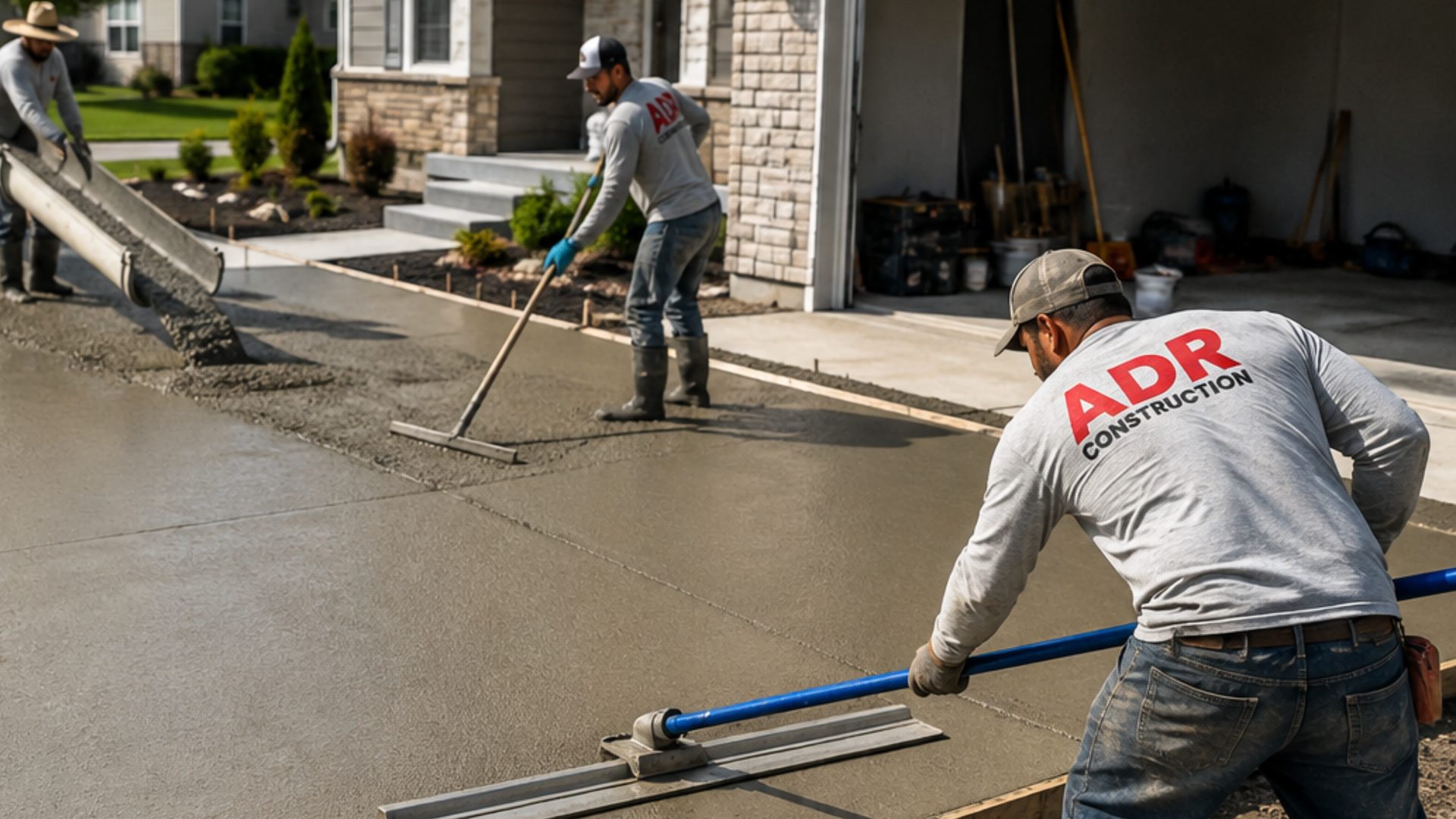
This is the single most underrated line item. If a mixer truck can back down and discharge directly into the forms, the pour is fast and the crew is small. If it cannot, concrete has to move by pump, power buggy, or wheelbarrow, and a job that took four hours takes eight. Narrow lots, mature trees along the approach, tight urban streets in older Durham neighborhoods, and backyard pours all fall into this category.
Removing the Old Driveway
Demolition on a replacement typically adds a couple of dollars per square foot once you account for breaking the slab, loading it out, and disposal fees. Thicker old slabs and any wire mesh or rebar buried in them cost more to remove. We handle demo, haul-off, base prep, and the new pour under one contract, which is worth confirming when you compare bids, because some quotes exclude removal entirely and it shows up later.
Grading and Drainage
Water is what kills driveways in the Triangle. If your current driveway sheds water toward the garage, pools in the middle, or dumps into a neighbor's yard, fixing that is part of the job, not an optional extra. Sometimes it is a simple slope correction. Sometimes it means a channel drain or reworking the exit point, and that is real money. Getting it right is cheaper than pouring a new slab on top of a drainage problem and watching the base wash out over five years.
Slab Thickness and Reinforcement
Four inches is our residential standard. Five to six inches is what we recommend when the driveway will carry RVs, trailers, boats, or work trucks. Going from four to six inches raises the concrete volume by fifty percent, so it is a meaningful cost jump, but it is far cheaper than replacing a cracked slab that was never thick enough. Reinforcement follows the same logic: wire mesh handles standard residential loads, rebar goes in when the slab is thicker or the soil is moving.
Piedmont Clay and Base Prep
Durham sits on Piedmont red clay, and clay swells when it takes on water and shrinks when it dries out. That movement is the most common reason driveways in this area crack and settle unevenly. Proper base work means excavating to a consistent depth, compacting the subgrade, and installing compacted crushed stone underneath the slab so the concrete is sitting on something stable rather than directly on clay that moves with the seasons.
This is also where the cheapest bids get cheap. Base prep is invisible once the concrete is down, so it is the easiest place for a contractor to save money without the homeowner noticing until year three. If one quote is dramatically lower than the others, ask specifically what base depth and compaction it includes.
Aprons, Curb Cuts, and City Permits
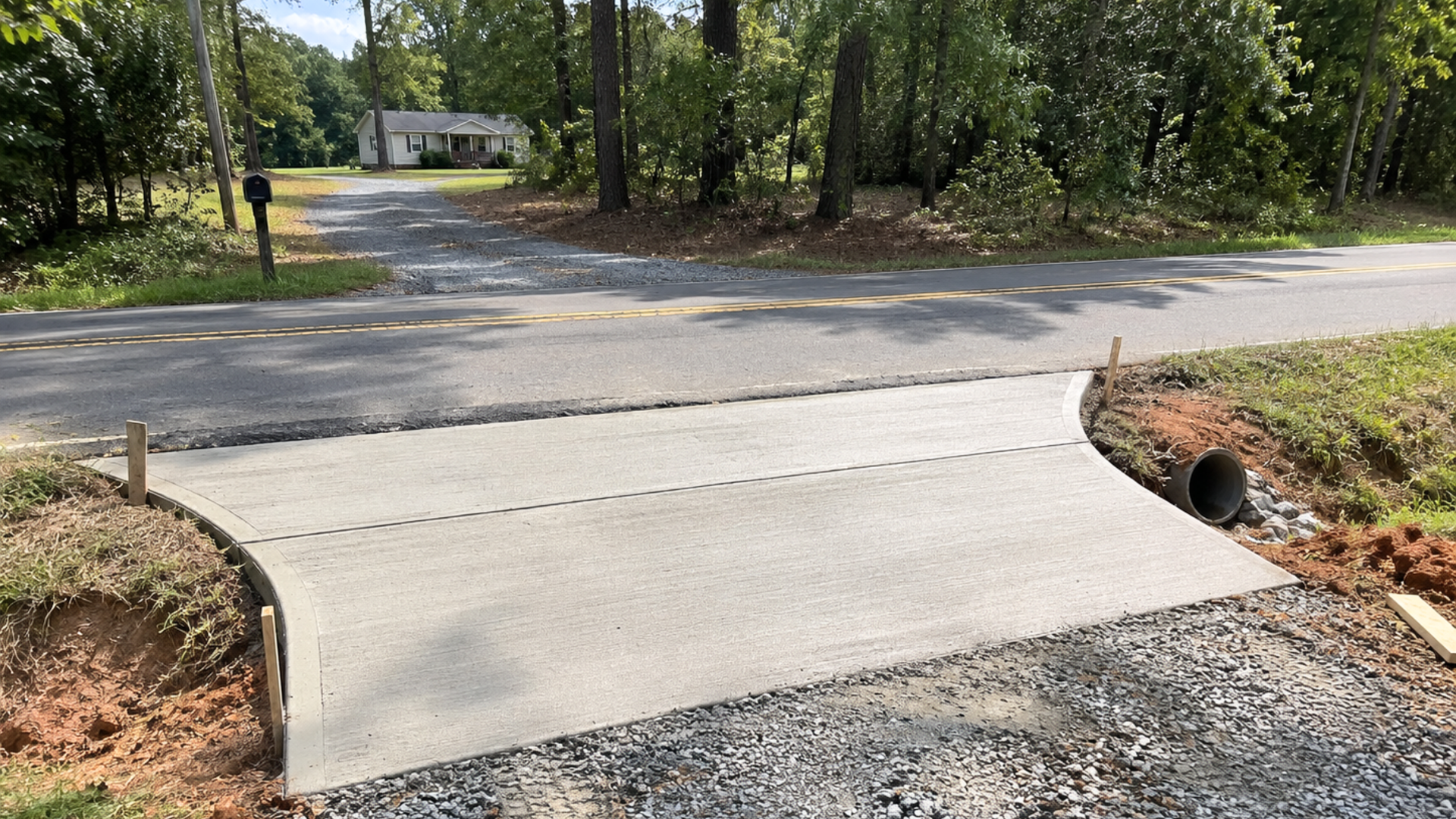
The apron is the section connecting your driveway to the street, and it takes more abuse than anything else on the property. If yours is failing or you are adding a new connection, the work may fall inside the public right of way.
In the City of Durham, any construction within the right of way requires a permit, and that includes driveways. Applications go through Minor Development Engineering, fees are paid before the permit is issued, and permits expire 90 days after issuance if no inspection has been requested. There is an exception for a new single family home driveway when the plot plan was submitted with the building permit. If your property fronts a state-maintained road rather than a city street, the driveway connection falls under NCDOT instead.
Straight in-kind replacement of an existing driveway on private property often does not trigger this. Anything touching the apron, the curb, or the street usually does. We flag which category your project falls into during the estimate so nobody is surprised by a permit halfway through.
How to Calculate the Cost of a Concrete Driveway
Step 1: Measure the Area
Multiply length by width in feet. A 20 foot wide, 30 foot long driveway is 600 square feet. For an irregular shape, break it into rectangles, calculate each one, and add them together. Include any parking pad, turnaround, or apron in the total.
Step 2: Pick a Realistic Per-Square-Foot Number
Do not default to the low end. Be honest about your site:
- Flat lot, open access, nothing to remove, standard 4 inch slab: start near $8 to $11
- Replacement with demo, decent access, minor grading: figure $11 to $14
- Demo plus tight access, drainage work, or a thicker slab: figure $14 to $18
Step 3: Add Your Finish Premium
If you want anything beyond a broom finish, add the finish premium per square foot on top of the number from step 2. Stamped work is the biggest jump.
A Worked Example
A Durham homeowner replacing a 20 by 30 two-car driveway, standard access, removing an existing 4 inch slab, no drainage issues, broom finish:
- 600 sq ft x $12 per sq ft = Estimated total: $7,200
Same driveway, but the old slab has rebar in it, the approach is tight, and they want a single-color stamped finish:
- 600 sq ft x $15 per sq ft = $9,000 base
- 600 sq ft x $5 per sq ft stamped premium = $3,000
- Estimated total = $12,000
Both are plausible quotes for the same driveway. The difference is entirely site conditions and finish, which is exactly why a real number requires someone standing in your driveway.
One More Number Worth Knowing
If you want to sanity-check a quote, figure the concrete volume. Square footage times slab thickness in feet, divided by 27, gives cubic yards. A 600 square foot, 4 inch slab works out to about 7.4 cubic yards, and crews order roughly ten percent extra for waste. Material is only part of a driveway quote, but knowing the volume tells you whether a bid is in the realm of reality.
Concrete Compared to the Alternatives
Cost per square foot only matters alongside how long the surface lasts and what it costs you every year afterward.
| Material | Upfront Cost | Typical Life | Ongoing Maintenance |
|---|---|---|---|
| Concrete | Higher | 25 to 30+ yrs | Minimal, optional sealing |
| Asphalt | Lower | 15 to 25 yrs | Sealcoating every few years |
| Pavers | Highest | Very long | Weeds, settling, re-leveling |
| Gravel | Lowest | Ongoing | Regrading and replenishing |
We pour concrete, so treat that comparison with the appropriate skepticism. The honest version is this: asphalt costs less to install and more to keep up, and it softens in Durham summer heat. Pavers look excellent and let you lift and reset a single section, but they cost the most and they need attention as the clay underneath moves. Concrete costs more than asphalt upfront and asks very little of you afterward. Which one wins depends on how long you plan to own the house.
Where Durham Homeowners Overspend and Underspend
- Overspending on decorative square footage. Stamping an entire 900 square foot driveway is expensive. Stamped borders around a broom finish center gets most of the visual effect for a fraction of the premium.
- Underspending on base prep. This is the one place where saving money reliably costs you more later.
- Overspending on thickness that is not needed. Six inches under a sedan is money in the ground. Save it unless something heavy is parking there.
- Underspending on drainage. Fixing where water goes during the pour is cheap. Fixing it after the base has washed out is not.
- Skipping the apron. Pouring a beautiful new driveway that meets a cracked, settling apron at the street undercuts the whole project.
How to Read a Concrete Driveway Quote
Bids that look wildly different usually differ in scope, not in price. Before you compare numbers, confirm every quote spells out:
- Total square footage and slab thickness
- Whether demolition, haul-off, and disposal are included
- Base preparation: excavation depth, stone type, and compaction
- Reinforcement type, mesh or rebar, and spacing
- Concrete strength, typically specified in psi
- Finish type and whether sealer is included
- Control joint layout and spacing
- Who pulls permits if the right of way is involved
- Warranty terms and what specifically is covered
- Payment schedule
If two quotes are $3,000 apart, one of the items above is almost always the reason. Ask which one before you assume somebody is overcharging.
Timing Affects Cost Too
Scheduling does not change the per-square-foot rate much, but it changes your options. Spring is the busiest season for every concrete contractor in the Triangle, which means longer lead times and less flexibility on dates. Fall and late winter usually get you a faster start. Our guide to the best time of year to pour concrete in Durham breaks down the calendar month by month if you are weighing when to schedule.
Frequently Asked Questions
How much does a concrete driveway cost in Durham, NC?
For most residential driveways in the Durham area, expect $8 to $18 per square foot for a standard broom finish. A typical 600 square foot two-car driveway lands roughly between $4,800 and $10,800. Where you fall in that range depends on site access, whether an old driveway needs removing, grading and drainage needs, slab thickness, and reinforcement. Stamped, colored, or decorative finishes cost more on top of that base.
Why is the price range so wide?
Because concrete driveway pricing is driven by site conditions more than by the concrete itself. A flat lot with open truck access and nothing to demolish is a fundamentally easier job than a sloped lot with a tight approach, an old reinforced slab to break out, and a drainage problem to correct. Same square footage, very different labor and equipment. The range reflects real differences in work, not variable markup.
Is it cheaper to resurface than to replace a driveway?
Sometimes, but less often than homeowners hope. Resurfacing only makes sense when the existing slab is structurally sound and the problem is cosmetic. If the driveway has settled unevenly, has cracks wider than a quarter inch, or sits on a failing base, a resurface just puts a new layer over a moving foundation and fails within a few years. We walk the driveway with you and give an honest read rather than pushing the bigger job.
Does removing the old driveway add much to the cost?
Yes, typically a couple of dollars per square foot once breaking, loading, hauling, and disposal fees are counted. Thicker slabs and any embedded rebar or wire mesh cost more to remove. We handle demolition, haul-off, base prep, and the new pour under a single contract, so you are not coordinating a separate demolition crew or paying disposal charges directly.
Do I need a permit for a driveway in Durham?
It depends on where the work happens. In the City of Durham, any construction within the public right of way requires a permit, and that includes driveway work touching the apron, curb, or street. Permits are reviewed by Minor Development Engineering and expire 90 days after issuance if no inspection has been requested. Straight in-kind replacement on private property often does not require one. If your property fronts a state-maintained road, NCDOT handles the driveway connection instead. We identify which applies during the estimate.
How thick should a concrete driveway be in Durham?
Four inches is the residential standard and handles normal passenger vehicles. We recommend five to six inches when RVs, trailers, boats, or work trucks will regularly use the surface. Thickness works together with base preparation and reinforcement, so we look at the whole picture during the estimate rather than defaulting to one spec. Going thicker costs more in concrete volume but is much cheaper than replacing a slab that cracks under loads it was never designed for.
How long does a concrete driveway last in Durham?
A properly built concrete driveway should give you 25 to 30 years or more. The variables that decide it are base preparation, drainage, slab thickness matched to actual use, and reinforcement. Durham's Piedmont clay makes base prep especially important, since clay expands and contracts with moisture and will move an inadequately prepared slab.
Why are contractor quotes so different for the same driveway?
Almost always because the scope is different, not the price. One quote may exclude demolition, specify a shallower base, use mesh where another uses rebar, or leave out the apron. Ask each contractor for square footage, slab thickness, base depth and compaction, reinforcement type, concrete strength, and what the warranty covers. Once those line up, the price comparison actually means something.
Get a Real Number for Your Driveway
Ranges are useful for budgeting and useless for deciding. The only way to know what your driveway costs is to have someone look at the access, the grade, the drainage, and what is already there.
ADR Construction has poured concrete driveway installation in Durham for over 20 years, and we cover the full Triangle. Check the areas we serve if you are outside city limits. Every estimate comes itemized so you can see exactly what you are paying for.
Request a free estimate and we will walk your driveway with you.